
It was just eleven days ago that an anti-abortion militant with white supremacist ties gunned down reproductive rights doctor George Tiller in a Kansas church. Just this past April, three Pittsburgh police officers were killed by a teen who believed the government was going to take his guns away, and had frequented white nationalists sites like Stormfront. In the heat of the presidential campaign last June, a gunman walked into a Unitarian Church and opened fire, killing two parisoners during a children's play; the shooter would claim the church's liberal values drove him to violence. And since the election of the first African-American president, gun-sales have risen alongside the daily dosage of rhetoric from conservative right-wing media. So today, after a right-wing white supremacist walked into the Holocaust Memorial Museum in Washington DC and opened fire, killing an African-American security guard, why is anyone even remotely surprised?
More after the fold...
It feels like de ja vu, after just covering these themes in the Tiller death. But I find it necessary to again point out that it was just this past April that the Obama administration's Department of Homeland Security released a memo warning of homegrown right-wing radical groups and their propensity for violence. Conservatives--both pundits and politicians--had a meltdown, claiming the government was outlawing opposing opinions and claiming they were being lumped in with racist hate groups. The American Legion soon jumped in, taking issue with the report's warnings of violent right-wing extremists recruiting disaffected one-time members of the armed forced. It was all utter nonsense of course, as the brief on domestic terrorism made no links to conservatism--the conservatives made that link themselves. And the concern of ex-military joining white supremacist groups is based on very recent facts, and in no way tarnishes all veterans. What should have been seen as a tempest in a teapot gained steam however as the media played in, allowing conservatives and right-wing ideologues--backed up by conservative leaning veterans groups--to cast themselves as victims of a liberal witch hunt. In days Homeland Security Secretary Janet Napolitano was making an apology for the "language" in the report.
But in the conservative and right-wing cries of foul over this memo, perhaps the lady doth protest too much.
While conservative pundits applaud and sensationalize FBI stings on terrorist fantasies of would-be "jihadists" (often suspiciously funded and aided by government informants), real-life acts of mayhem and murder by domestic right-wing terrorists go on right under our noses. Worse still, many of the most rabid conspiracy theories spouted by the likes of Glenn Beck, Michael Savage and Glenn Beck, serve as "intellectual" fodder for these gunmen. Yet no one in conservative television and radio noise machine is willing to take any responsibility or at the least tone down their rhetoric. In fact, they tend to lash out verbally at any insinuation places even a bit of blame on them. In the wake of George Tiller's death FOX host Bill O'Reilly, who had repeatedly called the doctor a "baby killer," claimed he himself in fact was a victim of the far-left.
Eric Boehlert at Media Matters is having none of it however:If Fox News is going to continue to traffic in hateful, vigilante-style rhetoric, then folks at Fox News, as well as their apologists in the GOP Noise Machine, are going to have to come up with better talking points to spin away the consequences of the right-wing madness they're so eager to incite....The Fox News crew is going to need better talking points because I fear the violence - the bouts of right-wing domestic terrorism - is likely to continue. As long as Fox News and the Noise Machine refuse to back off the incendiary language that they're actively mainstreaming, the political violence, visible just months into Obama's historic first term, may have only begun.
The reality is however that FOX News, while certainly wallowing in the cesspit of xenophobia, racism and intolerance to whip up the more fanatical of its base, did not invent any of this. They've certainly tapped into this angry sentiment and see it as a ratings bonanza, backing up faux-populist hate-rallies like the April "Tea Parties." Looks like Janane Garafalo was RIGHT.
But this type of racism and violence is unfortunately as American as apple pie and baseball, and follows a predictable pattern. When the economy falters and whites, usually disaffected angry males, feel under assault they find easy scapegoats they believe is behind their oppression. Fed along by media demagogues, a militarist gun-obsessed society, heroic vigilantism and an over-inflated patriarchal racial imaginings of their self-worth, they last out---often violently.
Back in 2006 during the emerging twilight of the Bush regime, retired veteran of the U.S. Army Special Forces Stan Goff wrote of this as a hypernormal state of Americana, which he asserts is normally racist, right-leaning and patriarchal if only on an institutional level:These explicitly white supremacist groups, contrasted with the implicitly white supremacist Republican Party, for example, openly embrace a vision of fascism, and openly admire fascist leaders....We need to first see for how long white supremacy has been considered ab-normal in the United States; then we can see how ab-normal it is right now....What is seldom examined in public discourse outside the universities and a handful of anti-racist political formations, is the question of what it means to be “white.” Thinkers from Toni Morrison to Noel Ignatiev to bell hooks to Theodore Allen to Mab Segrest to David Roediger have studied whiteness extensively, in its economic, cultural and political dimensions, and conclude unanimously that there is no “objective” measure for what it means; but that it is a social construction linked absolutely to social power. The insistence on existence of a white race, by racists and non-racists alike, is symptomatic of a form of mystification that conceals the concrete relations of power behind a set of widely accepted abstractions. White supremacy as a beliefhas evolved out of the practice of people in power, who defined themselves as white as a way of differentiating themselves from those over whom they wielded that power. Some very well-known American presidents who made openly white supremacist pronouncements were Woodrow Wilson, Theodore Roosevelt, and Richard Nixon. Of course, until the dismantling of Jim Crow in the South, white supremacy was a norm, and before the Civil War, slavery was a norm. White supremacy was so normal in 1964 that after the defeat of Goldwater, the Republican Party adopted thinly veiled racist appeals to attract white voters who felt betrayed by the reluctant Democratic Party support for civil rights legislation. Openly racist public officials like Jesse Helms, Strom Thurmond and Trent Lott, even after their affiliations with white supremacist organizations were publicized, continued to be elected. The Republican appeals to white supremacy were cloaked as opposition to welfare, as “states rights,” and as concern about “crime.” As late as 1999 the Republican-controlled House of Representatives blocked a vote to condemn the Council of Conservative Citizens, a white supremacist organization with whom then-Senate Majority Leader Trent Lott had close ties. How normed does something have to be before we can say it is normal?
And this brings us to a problem with the media, and in part even this blog. The coverage of these specific acts of violence, or even the focus on the hate spewed by FOX News acolytes and others, perhaps obscures a larger more unsettling truth that speaks to the pervasive nature of racism and whiteness in this country. We usually paint these individuals as lone bizarre gunmen driven by senseless hate---bad apples in our otherwise rational and tolerant "post-racial" society. The larger problem however is that there are throngs of these disaffected Americans--mostly white males--prone to believe conspiracy theories that blame Jews, immigrants, blacks and others for their plight. They don't fall out of the sky or come from some strange and mysterious place. They are borne and raised right here, in a society that seems to easily create such individuals and provide them the proper atmosphere for their hatred, xenophobia and violent tendencies to flourish. Tackling that "hard truth" may provide us some greater insight, that is if we dare.
Wednesday, June 10, 2009
Angry, Right & White America

Tuesday, March 3, 2009
Obama Administration to Boycott Racism Conference at Durban--Just like Bush

Photo used to illustrate issues of environmental racism at Durban I
At a time when racial conflict and discrimination are on the rise around the world, the Administration of the world's first black U.S. president will not be attending the world's most important conference on race and racism. In what may signal a dangerous new, "post-racial" approach to global race relations, President Barack Obama's Administration announced that it will not attend the second World Conference Against Racism, Racial Discrimination, Xenophobia and Related Intolerance in Geneva next April.--Robert Lovato, New American Media
When George Bush boycotted the Durban Racism Conference in 2001, I wasn't surprised. To see it happen again, under a black president, an icon of change, is not only disappointing but rises to a level of disgust.
More below the fold.
Bowing to what has become an overwhelming barrage of criticism from media punditry and political lobbying groups, the Obama administration claims the US--a country with a history of racism that is near legendary--cannot attend Durban because of perceived slights to Israel:
The U.S. and Israel walked out midway through that meeting over a draft resolution that singled out Israel for criticism and likened Zionism — the movement to establish and maintain a Jewish state — to racism.
It is telling that Israel takes such an affront to accusations of racism, much like apartheid South Africa objected to such labels, and as its sponsor (the US) once shunned such depictions from activists like Malcolm X--who threatened to take his case before the UN. Rather than engaging in discussion and debate, these states have simply opted to paint their critics as the actual pariahs.
But, though the Israel-slight mantra is easiest to hide behind, there were other problems that echoed the Bush administration's boycott, as pointed out by Lovato:
Other concerns cited by Administration officials, some of whom recently attended preparatory meetings in Geneva, in their justification of the boycott include a proposal to place restrictions on the defamation of religions and any language calling for reparations for slavery.
While I can see some apprehension to "restrictions on the defamation of religion" and know all-to-well how much the US winces whenever slavery (much less reparations) is brought up, that's hardly a worthy reason for a country with a history of Native American ethnic cleansing, slavery and Jim Crow apartheid to boycott a conference on racism. Durban II will also address issues as far ranging as the trafficking of women and children to rape in the Congo. All of this the Obama administration is giving up, because they disagree on some "wording." Talk about your baby with the bathwater.
Read full article by Robert Lovato of New American Media here.
Excerpts below:
At a time when racial conflict and discrimination are on the rise around the world, the Administration of the world's first black U.S. president will not be attending the world's most important conference on race and racism. In what may signal a dangerous new, "post-racial" approach to global race relations, President Barack Obama's Administration announced that it will not attend the second World Conference Against Racism, Racial Discrimination, Xenophobia and Related Intolerance in Geneva next April.
Increasing numbers of experts report that most continents -- Europe, Africa, Asia -- are seeing exponential growth in hate crimes, ethnic tensions and other manifestations of the racism, xenophobia and other forms of intolerance, the kind on intolerance that will be discussed at the Durban II Conference. And in the Américas, the very palpable rise in racial tensions, hate crimes and other discrimination are well illustrated by events here in the "post-racial" United States: the NY Post Chimpanzee cartoon scandal, the U.S. visit (including a film screening in Congress) by Danish racist Veert Wilder and the massive protests against the racial profiling, humiliation and other practices of Maricopa County Sheriff, Joe Arpaio, to name a few taking place in the United States. And these were only the events that the Obama Administration was silent about this past week.
The Obama Administration's silence on both these racial incidents and on such fundamentally racial -and global-problems as the "drug war," criminal justice reform and immigrant detention contrasts with the much-lauded statements on race by Attorney General Eric Holder. In statements made to coincide with the start of Black History Month, Holder called the U.S. "a nation of cowards" when it comes to discussion of race.
...with its very dangerous boycott of Durban II in response to pressure from the very powerful Israel Lobby , the Obama Administration may be giving the green light to governments and other groups practicing their own brand of racial discrimination, promoting hatred and other forms of discrimination. While much of the media is discussing the U.S. boycott, most of these reports neglect to the mention the near universal condemnation of the Israeli government's treatment of Palestinians, which United Nations General Assembly President Miguel D'Escoto likened to apartheid last November...
Friday, December 5, 2008
Obama, Slavery & the White House- "Bottom Rail on Top"

Slaves helped build the White House, both when it was built and later after it was burned down by the British during the War of 1812. Slaves helped build the US Capitol. One slave, Philip Reid, helped in the creation of the 12,000 lb bronze statue that now adorns the dome of the legislative building--the ironically enough named, Statue of Freedom. Slaves were sold and labored all throughout Washington DC. Some 12 American presidents owned slaves. Slavery was not abolished in Washington DC until 1862. And at one time, the mere inviting of a black man to the White House--from fiery abolitionists like Frederick Douglas to accomadationists like Booker T. Washington--was a source of controversy. President Woodrow Wilson not only had a private screening of D.W. Griffith's infamous Birth of a Nation in the White House--which depicted blacks as bestial rapists and the Ku Klux Klan as gallant heroes--but declared the film to be "like writing history with lightning....And my only regret is that it is all so terribly true."
Now, in just over a month, a black family is set to call the White House home. Even a cynic like me has to admit, that's probably a bit more than just symbolic. That's historic.
It was one of the first thoughts I had when I dwelt on the many meanings behind the triumph of Barack Obama. I first heard it mentioned publicly by Uruguayan writer Eduardo Galeano in a Democracy Now! interview the day following the election. "The White House will be his house in the time coming," said. "But this White House was built by black slaves. And I’d like, I hope, that he never, never forgets this." And it wasn't the only symbolic meaning that could be gleaned from history. Bill Moyers that Friday after the election pointed to a St. Louis rally Obama had held weeks earlier, that had drew a record 100,000 people. Lost in all of the election coverage, was that the rally was held on the steps of an old building that was once a courthouse--where slaves were auctioned and sold. In 1846, a slave named Dred Scott and his wife Harriett would appear on those courthouse steps to appeal their bondage. And though they would lose, their later Supreme Court appeal--Dred Scott decision--would become a part of history, fueling abolitionist sentiment towards a looming Civil War, eventual Emancipation, a century more of Jim Crow repression and the many acts of resistance that would shape the meaning of liberty, equality and democracy in America.
Barack Obama is interesting in that the only part of his lineage that experienced this drama was white. The other part, while dealing with the repression of British colonialism, can't point to a long history of American bondage, lynching, Jim Crow segregation and the dark sufferings of the Black Atlantic. Yet Obama chose to identify with that culture at an early age: partly by choice, and possibly partly by necessity--as America tends to baptize everyone into its racial landscape. And he chose to marry into that legacy through Michelle Obama, and consequently gave birth to children who are descended from it. And it is this complex drama of blackness that will call the White House home on Jan. 20th.
There's a memorable incident during the Civil War, where a black runaway slave who joined up with the Union army, catches sight of his former master--now a captured Confederate soldier. The slave saunters up to his previous owner, who sits stunned at this seeming reversal of fortune. "Hello massa," the ex-slave greets cheerfully, "Bottom rail on top this time."
Full article on topic below:
Slaves helped build White House, U.S. Capitol
By Susan Roesgen and Aaron Cooper
http://edition.cnn.com/2008/US/12/02/slaves.white.house/
WASHINGTON (CNN) -- In January, President-elect Barack Obama and his family will make history, becoming the first African-American first family to move into the White House -- a house with a history of slavery. In fact, the legacy of American presidents owning slaves goes all the way back to George Washington.
Twelve American presidents owned slaves and eight of them, starting with Washington, owned slaves while in office. Almost from the very start, slaves were a common sight in the executive mansion. A list of construction workers building the White House in 1795 includes five slaves - named Tom, Peter, Ben, Harry and Daniel -- all put to work as carpenters. Other slaves worked as masons in the government quarries, cutting the stone for early government buildings, including the White House and U.S. Capitol. According to records kept by the White House Historical Association, slaves often worked seven days a week -- even in the hot and humid Washington summers.
In 1800, John Adams was the first president to live in the White House, moving in before it was finished. Adams was a staunch opponent of slavery, and kept no slaves. Future presidents, however, didn't follow his lead. Thomas Jefferson, who succeeded Adams, wrote that slavery was an "assemblage of horrors" and yet he brought his slaves with him. Early presidents were expected to pay their household expenses themselves, and many who came from the so-called "slave states" simply brought their slaves with them.
Martin Van Buren, William Henry Harrison, Andrew Johnson and Ulysses S. Grant all owned slaves but not during their time in office. James Madison, Jefferson's successor, held slaves all of his life including while he was in office. During the war of 1812 Madison's slaves helped remove material from the White House shortly before the British burned the building. Michelle Obama uncovers slaves in her family .
In 1865 one of Madison's former slaves, Paul Jennings, wrote the first White House memoir: "A Colored Man's Reminiscences of Life in the White House." In the book, Jennings called Madison "one of the best men that ever lived" and said Madison "never would strike a slave, although he had over one hundred; neither would he allow an overseer to do it."
There were other presidents who treated their slaves less kindly.
James Monroe, Andrew Jackson, John Tyler, James K. Polk and Zachary Taylor all owned slaves while they were in office. The last of these, President Taylor, said owning slaves was a Constitutional right and he said slave-owners like himself would "appeal to the sword if necessary" to keep them. The Civil War, of course, put that opinion to the test.
Now, the Obamas are moving into the White House.
"The apple cart has been turned over here when you have the Obamas -- the first African-American couple -- now actually management and you are having in some cases white Americans serving them," says presidential historian Doug Brinkley.
Michelle Obama learned this year that one of her great-great grandfathers was a slave who worked on a rice plantation in South Carolina. She says finding that part of her past uncovered both shame and pride and what she calls the tangled history of this country.
For many, the historic election on November 4 marked a new beginning.
Though Michelle Obama's ancestors had to come through the ordeal of slavery, "Her children are sleeping in the room of presidents," said Brinkley. "It's a very great and hopeful sign."
Wednesday, October 1, 2008
The Reality of Everyday Racism
From The Daily Show, Sept. 29th.
So watch the video first, then read below:
The clip is no doubt hilarious--one of the funniest sketches I've seen in a while, and I was finally able to *laugh* at something done by Wyatt Cenac. What's most interesting however is the *very end,* or at least how it's been perceived. I saw this clip posted on numerous liberal blogs, where everyone talked about how funny it was, focusing on the elderly voters arguing over the election. What was hardly mentioned however was the ending--where two of the audience members speaking to each other first refer to Michelle Obama as a "big horse," and then go on to whisper about the "big thighs" of black women, and how it can denote their alleged "tribe." Maybe the lack of discussion on that facet had to do with the fact that these liberal blogs were majority "white."
Change that demographic make up, and the reactions become quite different.
To the many black forums I sent this to, it was those last comments that stood out. The response was often a mixture of laughter, shock, disgust, anger and other varied emotions. Black women especially commented frequently, on how degrading and humiliating those closing comments were--as Michelle Obama (a stand in for all black women) was reduced to a type of exotic specimen, sexualized, compared to an animal and subjected to several seconds of modern scientific racism.
As one black woman pointed out, what was most telling was that the closing comments were not even said with malice or cruel intent. There was no vile hurling of racial slurs, no conscious attempt to degrade Michelle Obama or black women in general. In fact, for all we know, these could have been supporters of Obama. Rather, the words and crude observations were made almost in passing--as casual conversation.
And so, once more, we have to wonder is this some aberration? Or is it simply a glimpse into everyday white America, hidden away from public discourse, kept off-camera, taken off-mic, swept away in an era where it's just not "politically correct" to state such things in "mixed" company. How many of those that may not voice it aloud, whisper it among themselves? How many more who dare not utter it, think it anyway? Exactly what goes through the heads of the white co-workers, authority figures, neighbors, colleagues, friends and others we interact with daily in our everyday lives. And, more important, how does it impact us?
And they wonder sometimes, why we seem paranoid...
*A previous related blog- The Pervasive Nature of Scientific Racism
Monday, July 28, 2008
Oh Where Have all the White Heroes Gone ?
Actor Matthew Mcconaughey as attorney Roger Baldwin in Spielberg's Amistad.
Actor and activist Danny Glover is steadily working on a biopic about the Haitian independence hero Toussaint-Louverture. But it's with no thanks to Hollywood. Glover said he "slaved" to raise funds for the film because financiers refused to back it. "I couldn't get the money here," Glover told the AFP. "I couldn't get the money in Britain. I went to everybody. You wouldn't believe the number of producers based in Europe, and in the States, that I went to." And what was the reasoning given by those who hold the purses? According to Glover, the monied interests in the movie industry complained there were no white heroes. "Producers said 'It's a nice project, a great project..." Glover recounted. "'Where are the white heroes?'"
Pay attention everyone, this is how whiteness works.
The white hero motif in black films is so tried and true, it has become a source of comedy in the black community--one of those private jokes black people laugh at together, of which many whites may be blissfully unaware. If Hollywood gets it into its mind to create a "black" film, and it deals with any topic pertaining to racism or oppression, rest assured a central white character will appear almost like magic.
Sometimes these white characters are actually pulled from history, and are used as the lens through which the story of the black main character or event is told. The 1987 film Cry Freedom followed this model, in which Denzel Washington played the role of murdered South African activist Steve Biko, but was overshadowed by the role of white actor Kevin Kline--who played Biko's journalist friend Donald Woods. Rather than focus on the singular inspiring and tragic life of Steve Biko, his white friend became a guide and a lens through which to view the apartheid struggle. The tagline for the movie read, "The true story of the friendship that shook South Africa and awakened the world." It was nominated for 3 Oscars.
By 1988, a year after the much acclaimed Eyes on the Prize documentary, Hollywood gave us Mississippi Burning, a film in which two FBI agents served as heroes for the entire Civil Rights Movement--doling out their righteous justice on Jim Crow. Played by Gene Hackman and Willem Dafoe, J Edgar Hoover's G-Men--far from the often neglectful, invasive and obstructionist figures remembered by many Civil Rights activists--are gallant and brave, doing their best not only to solve a brutal murder but protect hordes of frightened blacks who seem to spend much of the movie fleeing in terror from one set of whites or the other.
In 1996 the movie Ghosts of Mississippi, billed to be a story about the slain Civil Rights leader Medgar Evers, ended up being a film about Bobby DeLaughter--the white prosecutor who successfully convicted Evers' murderer in 1994. "Instead of portraying Medgar Evers's quest for justice, they gave us the moral dilemma of a white liberal," critic Willie Morris of the New York Times noted. Even Variety objected this time around, stating the movie left the false impression that the battles for racial equality ''were fought and won by square-jawed white boys.'' That very year, John Grisham's fictional work set to film, A Time to Kill, seemed to teach just that lesson, as a white lawyer (Matthew McConaughey) was left to defend a black vigilante (Samuel Jackson). Any black would-be heroes, in the form of a diminished NAACP, were depicted as selfish, corrupt and inept.
Yet despite the criticism of the Medgar Evers film, a year later in 1997, Hollywood showed it hadn't abandoned its "white hero" formula. Steven Spielberg would give us Amistad, a movie that was billed as a biopic of the famed slave leader Cinque and his band of rebels who successfully defeated the crew of a slave ship and commandeered it for themselves. That turned out however to only be the first few moments of the movie. Rather than a film about slavery, Amistad turned into a re-telling of the dramatic trial over the Amistad and the white men (including none other than founding father John Quincy Adams) who fought it. Director Spike Lee would derisively note that the black actors in the film, Morgan Freeman and Djimon Hounsou, amounted to little more than "furniture" to dress up the set.
The most absurd case can probably be seen in Melvin and Mario Van Peebles 1995 movie Panther, intended to tell the life of the 1960s Oakland based Black Panther Party for Self Defense founded by Huey P. Newton and Bobby Seale. The father and son team, in their search for funding, soon found that backing by Hollywood came with strings. Entertainment Weekly's article Power to the Peebles noted some of the bizarre requests studio executives made:At one pitch meeting, Mario recounts, it was suggested the movie would be more desirably ''mainstream'' if its story were told through the eyes of a white student radical, preferably one played by a Tom Cruise or a Brad Pitt. At another, it was suggested that since Jane Fonda had once supported the Panthers, it would be great if a role were written for her niece Bridget Fonda.
Rather than take the money and insert a fictional white character, the Peebles settled for a small budget that barely afforded them money to market the film. And in an ironic twist, they created a black fictional character through which to tell the tale of the Panthers--an act that was probably no less controversial than what the studios execs had in mind.
Seeming to realize the game, black director John Singleton's 1997 film Rosewood, a depiction of the black Florida town destroyed by a murderous white mob, came ready-packaged to Hollywood with a white hero in the form of Mr. Wright played by actor Jon Voight. Mr. Wright, based on John Wright, was a real historical figure who was reported to have let several blacks hide in his home. Wright is portrayed by Singleton as a conflicted soul caught up in the midst of the racial massacre. Yet the story is not told solely from his perspective. Instead, the key figure in the movie is a Mr. Mann--a fictional gun-wielding black superman played by actor Ving Rhames. In Singleton's inversion, this invented black hero acts as a force upon Wright, pushing the reluctant and morally questionable white hero into action.
If recent cinema history however is anything to go by, the white hero figure--although now a bit convuluted--still occupies a place in Hollywood storytelling. In the highly praised 2006 film The Last King of Scotland, the story of Ida Amin's brutal dictatorship is told from the perspective of white actor James McAvoy, who plays Scottish doctor Nicholas Garrigan. The movie is based on the book of the same name by author Giles Foden, whose Garrigan is a fictional character believed to be loosely (very loosely) based on former British soldier and colonial officer Robert Astles. In the film Garrigan is portrayed as a corruptible white young physician whose sexual appetites for African women and a lavish lifestyle, causes him to turn a blind eye to Amin's atrocities. Unlike Astles, who spent over six years in a Ugandan prison for his role in the regime, Garrigan finds redemption and escapes with his life. Though African-American actor Forest Whittaker received an Oscar as best male lead for his portrayal of Amin, more than a few black critics noted with irony that even the story of a black villain seemed to require a central white male presence.
A similar formula would be worked out for Blood Diamond, as Djimon Hounsou was cast in the role of a noble African fisherman opposite a rougish arms dealer (Leonardo DiCaprio) who manages to find his conscience in the end and become the life sacrificing great white savior for all of Africa.
As noted, some of the afore-mentioned films are historical, so the white characters in question may exist. Some are semi-historical, composites or loose interpretations of reality. Others are pure fiction. But the accuracy of the films isn't the issue I'm raising here. Rather, the question is, why do movies about black historical figures or events--namely tales dealing with racism or oppression--need to be told from either the perspective of a white hero or with whites in key roles? What is the basis of this formula?
After all, one can *choose* to tell the story of Steven Biko from his perspective--and not his white journalist friend. The story of Medgar Evers or Cinque can focus on these black figures as individuals in their own right, rather than the white lawyers out to secure their justice. Tales of Africa's blood diamonds don't *need* white interlopers that serve as centerpieces of the story. So what gives?
Perhaps it's a simple matter of money. Hollywood execs seem to fear that white audiences will not accept any film dealing with black people, oppression or racism without a white mediator to guide them--someone they can identify with or to help assuage any possible "white guilt." Perhaps the fear is that white movie-goers will assume that any film with an overwhelming and centralized black cast is a "black film," and will not reciprocate the courteous patronage blacks give to "white films" on a daily basis.
Whatever the case, it seems though Hollywood is far from ready for a black-centered movie on the Haitian Revolution, which struck fear in the slave regimes of the West, humbled Napoleon's France and helped alter the course of human bondage, it will nevertheless have to contend with Danny Glover's long awaited biopic. Funded from varied sources, including $18 million from Venezuela through the friendship of its leader Hugo Chavez, the film will feature a black cast as diverse as Don Cheadle, Angela Basset and Mos Def. Hopefully white movie-goers will prove Hollywood wrong, find interest in a movie in which they must accept their diminished roles and thus tell the gatekeepers of popular cinema to stop handling their "oh-so-fragile" white psyches with kid gloves.

Wednesday, July 16, 2008
White & Black & Obama

"Poll Finds Obama Isn’t Closing Divide on Race." So read today's NY Times headline. In the latest New York Times/CBS News poll, it was found that while there is excitement over the prospects of America's first black president, its meaning is viewed quite differently depending on one's "racial" lens. While whites polled believed this historic event would signal a watershed in race relations, blacks polled--while enthusiastic about Sen. Obama--shared no delusions that an Obama presidency would herald a new age of racial harmony. In fact, many believed things to be the same or worse today than just four years or a decade prior. As the Times put it, "Black and white Americans agree that America is ready to elect a black president, but disagree on almost every other question about race in the poll."
Yeah, tell me something I don't know...
According to the poll:
Nearly 60 percent of black respondents said race relations were generally bad, compared with 34 percent of whites. Four in 10 blacks say that there has been no progress in recent years in eliminating racial discrimination; fewer than 2 in 10 whites say the same thing. And about one-quarter of white respondents said they thought that too much had been made of racial barriers facing black people, while one-half of black respondents said not enough had been made of racial impediments faced by blacks.
Hardly a surprise here. The notion that things are not as bad as black people think, that racism and oppression are more so figments of our minds than reality, has been a common mantra among white America as far back as the end of the Civil War. Then, as now, whites claimed blacks had achieved all they desired or needed to succeed and declared the project of ensuring equality over. Deciding 100 years later, after a history of Jim Crow repression, disfranchisement and white terrorism, that perhaps they were wrong, white America--pushed and cajoled by black protest and agitation--decided to once again "level the playing field." Within a few years, white America decided things were much better and blacks had never had it so good--and immediately set about dismantling every facet of the Civil Rights Bill they could, helping in part to fuel the growing Conservative movement. With a black candidate poised to perhaps take the White House, white America is more certain than ever that blacks have "overcome." From pundits like George Will and Chris Matthews, the Obama candidacy is hailed as the virtual "end of racism"--or at least the end of black people whining about it.
The NY Times article noted the following:
In this latest poll, over 40 percent of blacks said they believed they had been stopped by the police because of their race, the same figure as eight years ago; 7 percent of whites said the same thing. Nearly 70 percent of blacks said they had encountered a specific instance of discrimination based on their race, compared with 62 percent in 2000; 26 percent of whites said they had been the victim of racial discrimination. (Over 50 percent of Hispanics said they had been the victim of racial discrimination.)
If anything, experience is one heck of a teacher--provided it doesn't kill you first. Living while black or brown is not something whites have to contend with. Thus acts considered to show subtle or even blatant racism to those who experience it daily, may be lost on others who do not have to live that reality. What many people of color may be well aware of is that while an Obama presidency might be phenomenal, and quite symbolic, it won't solve the everyday problems of race in their lives. Having Obama as president isn't going to lessen unwarranted stops and searches by police. It won't eliminate racial profiling (although the Illinois Senator has admirably worked towards this). And it won't stop the innate concern that getting stopped by law enforcement could inexplicably escalate to a deadly confrontation, even if you're wholly innocent of any crime.
More from the article:
And when asked whether blacks or whites had a better chance of getting ahead in today’s society, 64 percent of black respondents said that whites did. That figure was slightly higher even than the 57 percent of blacks who said so in a 2000 poll by The Times.
That white America so joyously thinks things are getting better with each passing minute is amazing--given the fact that most of them aren't working to end white privilege, that invisible force that permeates institutions, systems, culture and more of our society. You'd think with such rosy outlooks, masses of white America were working daily steeped in studies on whiteness and reading Tim Wise articles by the bulk. If anyone is puzzled at how black people can be so pessimistic about opportunities and race, take the following Mar 2008 report by United for a Fair Economy into account.
*Due to the subprime lending catastrophe, the greatest loss of black wealth is unfolding. People of color have collectively lost between $164 billion to $213 billion over the past eight years.
*Given historic unfair discriminatory practices regarding homeownership, white wealth had been allowed to accumulate while blacks were left behind. Even though blacks began closing these gaps in the 1970s, even at such a steady pace it was estimated that it would still take 594 years-more than half a millennium-for blacks to catch up with whites in household wealth.
*Worse yet, that number was *before* the subprime lending catastrophe struck. Taking the loss of wealth into account, at current rates it would take a staggering 5,000 years before blacks achieve homeowner parity with whites.
We could go on discussing everything from a prison industrial complex, poor healthcare, enviromental racism, unfair drug laws, impoverished communities and more. Add in numerous studies that show continued acts of discrimination--even white felons have a better chance of landing a job than blacks with no criminal record--and we could question just whose view of reality is more accurate.
And the number of blacks who described racial conditions as generally bad in this survey was almost identical to poll responses in 2000 and 1990.
So how is it many are puzzling, that with things as bad as black people claim, we may possibly see an emerging black presidency? The problem here is thinking that Obama the man somehow translates into all of black America. While I never entertained silly notions cooked up by the likes of Stanley Crouch and Deborah Dickerson--who are aptly called the eternal black contrarians--as to whether Obama was "black enough," at the same time I knew that how whites viewed his race had alot to do with his success. Let's be blunt. Obama is just black enough in white eyes without being too black. What is "too black?" Think Jesse Jackson, or Rahim on the block--that is, anyone who might file a grievance against American racism. It's not only that Obama fits middle class American norms, or that he is bi-racial, it's that white America has decided to project on him their idea of what they would like black people to be. Were he anything else, anything that threatened to make them uncomfortable in their whiteness, they'd skittishly run to the hills and steer clear of his candidacy--like many of the more xenophobic members of the right. We almost saw just that, when the white world (liberal, moderate and conservative alike) were shocked to hear his former pastor Rev. Wright utter sentiments commonly heard (even if not wholly believed) in the black community, but utterly alien to white ears. Of course, Obama's appeal as the "friendly black candidate" remade to fit white expectations isn't his fault. But I'm more than certain he is as aware of it, and probably uses it to his benefit--as much as we *all* do in our everday lives.
So it looks like the good news is we may have a black president. The bad news is, we can't substitue a symbolic victory for the real racial and social equality. That is work in which both sides of the Hegelian power relationship will have to engage.
Wednesday, December 26, 2007
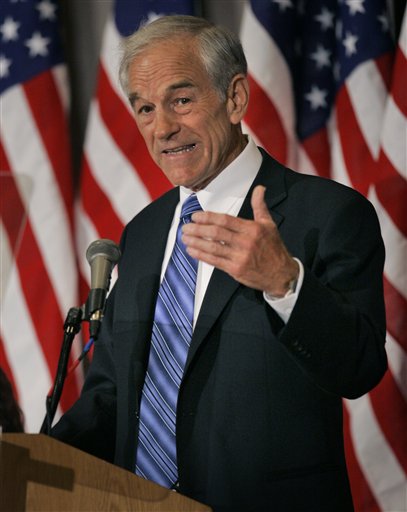
Ron Paul Doesn't Like Black People ?
"Indeed, it is shocking to consider the uniformity of opinion among blacks in this country. Opinion polls consistently show that only about 5% of blacks have sensible political opinions, i.e. support the free market, individual liberty, and the end of welfare and affirmative action.... Given the inefficiencies of what D.C. laughingly calls the "criminal justice system," I think we can safely assume that 95% of the black males in that city are semi-criminal or entirely criminal."
And who made that wonderful comment? Was it (a) David Duke (b) Dick Cheney or (c) Bull Connor? Nope. Those statements were made--or endorsed depending on who you believe--by none other than Presidential hopeful and Republican Congressman (D-TX) Ron Paul. Yes, the same Ron Paul that comes off so sensible and good-natured on television. The one the media has told you to "watch out for" as a dark-horse candidate. The Ron Paul who seems like a good guy cuz, gosh, he's anti-war and doesn't want to bomb Iran. Problem is, Ron Paul may agree with alot of things many on the Progressive Left do, but for entirely different reasons. He's a self-declared Libertarian, which has so many sub-sets its hard to define the term. In Ron Paul's case, he sees most things that deal with big government as infringing on natural liberty. So naturally, he's anti-military spending and would not have invaded Iraq. Yet in his view of libertarianism, he'd probably also not lift a finger to stop genocide in Darfur--no foreign involvement means no involvement. Sure he's anti-NAFTA, but not because like activist Ralph Nader he is concerned about the plight of the global worker, but because he's an "America First" type who wants to free the American worker (usually white) from corporate slavery. He'd do away with the Patriot Act, certainly...right after he does away with Affirmative Action, Social Security and a host of other "government" enforced items.
That his notions on black people is so dismal should not be surprising, as libertarians tend to enforce their views on limited government by denying things like racism or sexism exist--and therefore do not need to be regulated by government with pesky notions like Civil Rights or Equal Opportunity laws--which again may infringe on the natural liberty of others. Of course, Ron Paul's campaign denies he ever made these statements. Rather they were taken out of context or attributed to him in a newsletter that he sanctioned. While Paul says he takes "moral responsibility" for the publication, he thus far has not condemned or repudiated the statements "attributed" to him. Go figure. But hey, why take my word for it? Thanks to the nice people at the Daily KOS, let Ron Paul--or his doppelganger--speak for himself. Quite illuminating...
from a 1992 peice titled: "LOS ANGELES RACIAL TERRORISM," following the Rodney King riots in 1991:
Regardless of what the media tell us, most white Americans are not going to believe that they are at fault for what blacks have done to cities across America. The professional blacks may have cowed the elites, but good sense survives at the grass roots. Many more are going to have difficultly avoiding the belief that our country is being destroyed by a group of actual and potential terrorists -- and they can be identified by the color of their skin. This conclusion may not be entirely fair, but it is, for many, entirely unavoidable.
Indeed, it is shocking to consider the uniformity of opinion among blacks in this country. Opinion polls consistently show that only about 5% of blacks have sensible political opinions, i.e. support the free market, individual liberty, and the end of welfare and affirmative action.... Given the inefficiencies of what D.C. laughingly calls the "criminal justice system," I think we can safely assume that 95% of the black males in that city are semi-criminal or entirely criminal.
If similar in-depth studies were conducted in other major cities, who doubts that similar results would be produced? We are constantly told that it is evil to be afraid of black men, but it is hardly irrational. Black men commit murders, rapes, robberies, muggings, and burglaries all out of proportion to their numbers.
Perhaps the L.A. experience should not be surprising. The riots, burning, looting, and murders are only a continuation of 30 years of racial politics.The looting in L.A. was the welfare state without the voting booth. The elite have sent one message to black America for 30 years: you are entitled to something for nothing. That's what blacks got on the streets of L.A. for three days in April. Only they didn't ask their Congressmen to arrange the transfer.
from a Houston Chronicle report from 1996:
Texas congressional candidate Ron Paul's 1992 political newsletter highlighted portrayals of blacks as inclined toward crime and lacking sense about top political issues.
Under the headline of "Terrorist Update," for instance, Paul reported on gang crime in Los Angeles and commented, "If you have ever been robbed by a black teen-aged male, you know how unbelievably fleet-footed they can be."
Paul, a Republican obstetrician from Surfside, said Wednesday he opposes racism and that his written commentaries about blacks came in the context of "current events and statistical reports of the time."
... [I]n the same 1992 edition ... [Paul wrote], "We don't think a child of 13 should be held responsible as a man of 23. That's true for most people, but black males age 13 who have been raised on the streets and who have joined criminal gangs are as big, strong, tough, scary and culpable as any adult and should be treated as such."
Paul also asserted that "complex embezzling" is conducted exclusively by non-blacks.
"What else do we need to know about the political establishment than that it refuses to discuss the crimes that terrify Americans on grounds that doing so is racist? Why isn't that true of complex embezzling, which is 100 percent white and Asian?" he wrote.
Ron Paul on Congresswoman Barbara Jordan, D-TX:
"University of Texas affirmative action law professor Barbara Jordan is a fraud. Everything from her imitation British accent, to her supposed expertise in law, to her distinguished career in public service, is made up. If there were ever a modern case of the empress without clothes, this is it. She is the archetypical half-educated victimologist, yet her race and sex protect her from criticism."
Excerpts: Daily Kos, May 15th, 2007
Friday, October 19, 2007
The Pervasive Nature of Scientific Racism
Today the TimesOnline is stating that the 79-year-old scientist James Watson who won the Nobel prize for his part in discovering the structure of DNA, is back-pedaling from an interview in which he asserted that black African and Caribbean workers were inferior in ability and intelligence to whites. Watson, who has offered his apology, claims he is "mortified by the public response," and that the Sunday Times who performed the interview somehow misconstrued his words. The newspaper however says the interview was recorded, and is sticking by their story. While outrage and apologies now fill the air, what the Watson controversey has brought to the surface is the sometimes forgotten and neglected stepchild of white supremacy: "scientific racism."
The Pervasive Nature of Scientific Racism
by Morpheus
This week the London's Science Museum canceled a lecture by Nobel Prize-winning geneticist James Watson—part of the two-man team that first constructed the model of the DNA double helix—after the scientist told a newspaper that Africans and Europeans had different levels of intelligence. Watson provoked widespread outrage when his comments were released in a Sunday Times interview, which quoted the 79-year-old American as saying he was "inherently gloomy about the prospect of Africa" because "all our social policies are based on the fact that their intelligence is the same as ours — whereas all the testing says not really." Watson would add, "people who have to deal with black employees find this not true."
This isn't the first time Watson's comments have stirred controversey. As the UK Independent catalogued, the Nobel prize-winner has had a series of controversial statements. In one instance, he suggested women should have the right to abortions if tests could determine their children would be homosexual. In 2000 at a speech at the University of California, Berkeley, he claimed a link between skin color and sex drive, showing slides of bikini-clad women and asserting that higher doses of melanin was responsible for the stereotype of the "Latin Lover."
Most news reports state that people are "shocked" by Watson's comments. Outrage comes next, along with his dismissal as a "crazed." More often than not, he is described as "controversial." Even with a repeated history of such rhetoric however, Watson's historical standing assures that he is invited to speak to large audiences, and still sought out for interviews. As a 1990 article in the journal Science noted: "To many in the scientific community, Watson has long been something of a wild man, and his colleagues tend to hold their collective breath whenever he veers from the script." Translated: Many fear that Watson may dredge up the often closeted stain on the discipline of "rationality and reason"—scientific racism.
Today mostly thought of as debunked, "race science" was once taken as a normal part of academic and scientific discourse. One of its early progenitors in the modern era was probably none other than American founding father Thomas Jefferson, who in his Notes on the State of Virginia deduced from his "observations" that blacks exhibited a childlike simplicity, a wild imagination, an incapacity to reason and an inability to create artistry comparable to whites—for which he would single out black poet Phyllis Wheatley for particular criticism. Jefferson would go on to make reference to the "disagreeable odour" of blacks and claim that "the Oran-ootan (Orangutan)" had a preference "for the black women over those of his own species." Around the same time the naturalist Edward Long in his work A History of Jamaica, would compare black Africans to "dogs" and make the claim that black women sought out monkeys and baboons to "embrace" to gratify their raging sexual passions. Racism was not out of ordinary in the era of Jefferson and Long, during which time the slave trade in African bodies was booming and building up the wealth of the Western world. Yet both men were some of the early few who were beginning to assert that black inferiority was a "natural" state, that could be backed up by scientific observation. In a methodology fraught with irony, the same naturalism that would allow Jefferson to deduce the "natural rights" of man, was used to assert that some men, and women, were "naturally" inferior. Blacks were no longer simply "barbarous" due to a degradation of civilization in a jungle climate, or because they had not been introduced to the "light of Christianity." Rather blacks were inferior to whites and distinctly different on a "natural" biological level that could not be overcome, and that could be backed up by what Long would assert was "matter endued with thought and reason!"
Modern scientific racism was being given birth.
Nurtured within the developing scientific disciplines of its day, it would come to typify European notions towards blacks and those deemed as inferior "others." By the late 19th century it had ascended to the top of the white supremacy rationale ladder, churning out myriad theories that claimed a scientific basis as to the inferiority of non-whites, and blacks in particular. As far back as the early 1800s, black bodies would be cut open and studied as exotic specimens, to be passed around and examined for scientific inquiry by the likes of George Cuvier—regarded as the founder of modern day comparative anatomy. Such was the fate of 'Sara' Baartman—the Khoi woman dubbed the “Hottentot Venus” who was paraded through London and Paris on a leash. Upon her death—following a descent into prostitution through which she contracted syphillis—Cuvier made a plaster cast of her body, dissected her and preserved her organs, including her genitals and brain, in bottles of formaldehyde. Her skeleton and bottled remains were displayed at the Musée de l’Homme in Paris until 1974, until public pressure sent them to a back room away from sight. The museum did not return her remains until 2002.
And Baartman's case was hardly unique.
From 1845 to 1849, scientific racism allowed Dr. Marion Sims, the father of modern gynecology, to carry out horrific medical experiments on the genitals of unwilling and un-anesthetized slave women. Scientific racism would allow numerous such ethical violations in the name of medicine upon black bodies—from the U.S. government’s Tuskegee experiment to other notorious acts carried out by slave owners, the armed forces, the CIA, prisons, and private institutions. The sheer scope of these atrocities is only now becoming understood, through groundbreaking studies such as Dr. Harriet A. Washington's work, Medical Apartheid: The Dark History of Medical Experimentation on Black Americans from Colonial Times to the Present.
And scientific racism was not confined to medicine. It seemed to find a place in any field dedicated to the study of humanity. Proto-anthropologist and naturalist Samuel G. Morton would create an entire field by which human skulls were measured for racial markers of intelligence, ushering what many see as the definitive modern age of scientific racism. In none other than the pages of the now well-respected Scientific American, was an article in the early 1900s on "Congo pygmies," who were described as "small, apelike, elfish creatures, furtive and mischievous." It went on to state that these smallish Africans "closely parallel the brownies and goblins of our fairy tales.." and "live in the dense tangled forests in absolute savagery while they exhibit many ape-like features in their bodies...." Little surprise then that in 1906 Ota Benga, a so-called "pygmie" duped into leaving his African homeland with claims of payment and fortune, would be locked into a cage at the Bronx zoo, to be displayed as a type of ape.
Scientific racism would eventually merge with the related and now rogue—but at one time en vogue—branch of biology known as eugenics. Postulated by Sir Francis Galton in 1865, eugenics proposed that human behavioral traits—and talents—could be discerned through hereditary analysis. Eugenics would assert that certain undesirable traits could be eliminated from the human species. At times seemingly concerned with general matters as height and illness, eugenics also had a more sinister side—asserting that some humans needed to be eliminated (or sterilized) in order to better the species. The targets for sterilization included the mentally challenged, the physically deformed, the poor, the ill and—naturally—the more "undesirable races." In the U.S. this would result in everything from stricter immigration laws to limit more "inferior whites" (normally the Irish or Eastern Europeans), and the tightening of anti-miscegnation laws that became tied to black lynching. Some 60,000 people in the U.S. alone may have been coercively sterilized in a campaign author Edwin Black termed, the War Against the Weak.
While not all scientists were hardcore eugenecists who believed in mass sterilization or extermination, for many race science and the belief in "weaker humans" was taken as a matter of fact. Scientific racism, even in its least malign form, thus permeated the discipline not as a fringe element but as part of the mainstream discourse. From President Woodrow Wilson to women's reproductive activist Margaret Sanger, all stratum of society embraced elements of eugenics (to varying degrees) as a way to strengthen the human race—most especially, the white Nordic variant. Sanger for instance may have believed that some humans were "the defective progeny resulting from irresponsible and unintelligent breeding," but strongly condemned any attempts at forced sterilization. Ironically the pinnacle of eugenecist theory and scientific racism coincided with its demise. One of its biggest admirers was none other than Adolf Hitler, who endorsed the theories and applications of eugenecists in Europe and America for his Nazi ideology. After the world witnessed the use of scientific racism in the Third Reich to create an Aryan master race and to justify the extermination of millions, race science and eugenics saw a precipitous decline. Sanger herself was so horrified by the Nazi excesses she backed away from earlier endorsements of eugenics, but would still advocate it as an individual and voluntary decision.
But, as Dr. Watson reminds us, race science and eugenics never truly died out. Nobel Prize winner Hank Shockley in the 1970s, converting to eugenics later in life, became a staunch advocate for the belief that the less intelligent (which in his mind, by default, included blacks) should be given incentives to not breed with other humans. Mimicking scientific racism and eugenics, 60 Minutes commentator Andy Rooney in 1990 would assert that, "blacks have watered down genes because the less intelligent ones are the ones that have the most children." In 1995 scientific racism's boldest modern public salvo was launched with Richard J. Hernstein and Charles Murray'sThe Bell Curve,which linked IQ to race with blacks being deemed as naturally inferior. Though sparking controversy and condemnation, the book was also widely touted in the mainstream media as at the least a legitimate topic of discussion. Malcolm Browne of the New York Times would be so deferential in his review of the book, many took it as an endorsement. Today foundations like the well-monied Pioneer Fund openly advocate for race science, and advocate for changes in public policy based on scientific understandings of race.
What Dr. Watson and the history of scientific racism does is put a lie to the myth that racism is the domain of the uneducated, the ignorant and misinformed. The sad but hard reality is that racism is bigger than a disgruntled white underclass in hoods and sheets or nooses that proliferate as warnings and "pranks." Racism has a much more permeable, lasting and influential presence in the institutions, structures and culture of our society—where true power resides. And it has a long history of infecting even those among us who 'claim' to have the biggest and best of brains.

Tuesday, October 16, 2007
Let's Do it Again- The Cos is Back!
It's been a while since America's favorite father turned "denouncer of black morality" has been in the headlines. But have no fear the Cos is back, touting a new book called Come on People: On the Path from Victims to Victors. The work marks a new salvo in the one-time comedian's bitter old man routine, in which he chastises the black poor, single black mothers and black youth killed while allegedly stealing pastries. When Cosby first made his tirade a few years back, there were a few of us who found his hate speech distasteful. Many other black people however seemed to give in. Deciding that Cosby's "blame-the-victim" classist rant was spot on, they applauded his Colbert type "truthiness." Thankfully to sane minds everywhere, the past few years have seen a debunking of the "Cosby Thesis." Historians like Jelani Cobb would point out the fallacies in Cosby's claims, and others like Michael Eric Dyson questioned his sanity. Even academic studies have deconstructed Cosby's claims. But this didn't stop white America--and the mass media--from applauding the former comedian and philanthropist, that seemed to say everything they'd always believed and wanted to hear. Not surprisingly, with the release of this new book, Cosby is getting alot of airtime to explain why the black poor and black people in general are to blame for their own problems. Thankfully, once again, saner black minds are speaking out in criticism. A few of their articles are posted here.
In this article at the Black Agenda Report, Glen Ford gives both review and criticism of Cosby's new book. According to Ford, the book's co-author, noted psychiatrist Dr. Alvin Pouissant, helps soften the Cosby thesis by offering much needed caveats. I'm a bit suspect about that claim, as the Dr. Pouissant I am used to hearing from--long-time friend of Cosby and advisor to his television show--seems to uphold much of the ideologies of the Afro-stocracy. In any case, Ford still pulls no punches, and points out that in the end--even with Pouissant's assistance--the book itself remains misguided.
Black Psychiatrist's ‘Intervention' Calms Cosby
by BAR executive editor Glen Ford
"When presented as a substitute for political action, books like Come On People are great diversions from the tasks at hand, and weapons to bludgeon Black people."
Bill Cosby is sounding (almost) calm and reasonable, these days, under the influence of Dr. Alvin Poussaint, respected Harvard psychiatrist and co-author with Cosby in a new book. Despite his improved demeanor, Cosby's blame-the-victim worldview remains compatible with the most rightwing foes of African Americans. The no-longer-funny comedian's hectoring and "burnished anecdotes of times past are near-useless as a guide to either personal behavior in the present, or organized community action." But the corporate media gorges itself on the red-meat of Cosby's Black-bashing - and that's all that matters for book sales. Dr. Poussaint can only do so much to fix a 70-year meanness.
full article:
Black Psychiatrist's 'Intervention' Calms Cosby"
In this article, Earl Ofari Hutchinson takes on the Cosby Thesis and his new book. Given what has been Hutchinson's seeming tilt to black conservatism in the past few years (see my own criticism of his articles during the Don Imus affair), I was pleasantly surprised to see that on this issue we are in general agreement. Hutchinson points out that Cosby's book serves as little more than a way to attack black people without giving due consideration to the 800 lb gorilla of white supremacy racism.
Bill Cosby's New Book Full of Racial Stereotypes
By Earl Ofari Hutchinson, AlterNet.
Posted October 15, 2007
Cosby's new book continues to tar black communities and the black poor as dysfunctional, chronic whiners, and eternally searching for a government hand-out.
Comedian Bill Cosby is the walking and now writing proof of the ancient adage that good intentions can go terribly awry. That's never been more painfully true than in Cosby's latest tome, Come on People.
Cosby and his publisher boast that the book is a big, brash, and provocative challenge to black folk to get their act together. That's got him ga ga raves, and an unprecedented one hour spin job on Meet the Press.
In the book, Cosby harangues and lectures, cobbles together a mesh of his trademark anecdotes, homilies, and personal tales of woe and success, juggles and massages facts to bolster his self-designated black morals crusade. Stripped away it's the same stock claim that blacks can't read, write or speak coherent English, and are social and educational cripples and failures.
full article:
Bill Cosby's New Book Full of Racial Stereotypes

Thursday, September 13, 2007
Black Snake Moan vs Megan Williams
Okay... So by now everyone has heard of the ordeal of Megan Williams, the young black woman who police say was kidnapped, tortured and repeatedly sexually abused for a week long ordeal in Charleston, West Virginia. Williams mother says she was chained, sexually assaulted, doused with hot water, stabbed, forced to eat animal feces, and taunted with racial slurs (n*gger). Six whites, two of them women, were arrested and now face a multitude of charges. Wonder if Craig Brewer, the white guy who showed us a black pimp can cry in Hustle & Flow, and that the long-time southern fantasy of 'white woman slavery' does exist after all in the not-so-subtle symbolisms of Black Snake Moan, will tackle this in his next film?
While news of this bizarre case has been noteworthy, it has interestingly enough not reached the heights of accused dog torturer Michael Vick, or any number of reports featuring missing white girls or young women. The reality is of course that statistics show the sexual abuse of girls and women in American society is a common occurrence. Megan Williams' case compounds the issue by its sheer extremities and the intersections of race and gender in the South. If any serious discussions were to be had, a Pandora's box of American issues of violence, race and women of color could be opened up--but not likely. Instead, the most we'll get are inverted stories like Brewer's Black Snake Moan, that seek to bury harsh realities under complicated symbolic fantasies. Go figure.
At any rate, of all the op eds I have seen on this topic, the best thus far has been from James Peterson at Black Prof.com, who places the issue in a larger perspective.
His piece is reposted in full below:
Why Megan Matters
by James Peterson
First, my heart goes out to Megan Williams, her parents: Carmen and Matthew Williams, as well as her family and the community of Charleston, West Virginia; who, like most of us, must be shocked, outraged and utterly disturbed by the heinous hate crimes that took place in that trailer home located in Logan County.
The agonizing situational irony of this story “breaking” on the sixth anniversary of 9-11 puts into bold relief the sentiments of several or our leading public intellectuals and the abiding sense amongst some African Americans that the so-called War on Terror is misplaced and misdirected if one considers for one moment the consistent acts of terror committed against women and people of color in this country.
After their appearances on HBO’s Real Time with Bill Maher, both Cornel West and Hip Hop artist/activist/actor Mos Def were lambasted by mainstream media for their “extreme” views on Osama Bin Laden, the attack on the twin towers, and American efforts to combat terrorists over seas. Dr. West and others like Dr. Michael Eric Dyson have clearly attempted to re-center any discussion on terror around the experiences of Black Folk in this country in order to provide a reasonable context for why some people simply cannot stomach an American policy that is inherently hypocritical if it does not root out terror in its own back yard.
The fact that these acts of racist terror are executed by American citizens (and I use this term very loosely here) should provide proof positive for Dyson’s and West’s reasonable suggestions that some people of color simply can not genuinely connect themselves to the patriotic machinery that invites us to hate “Islamic Fascists” or to accept a permanent war allegedly committed to eradicating evil overseas when so much evil still lurks right here, in West Virginia, in Louisiana, in New York, Texas, Wyoming or (insert heinous hate-crime locale here) AMERICA.
Six white West Virginians (Frankie Lee Brewster, age 49, Bobby Brewster, 24, Danny Combs, 20, George Messer, 27, Karen Burton, 45, and Alisha Burton, 23) have been charged with the kidnapping, malicious wounding, battery, and sexual assault of 20 year-old Megan Williams. Over the course of a week-long, unimaginable and I am sure for her, unending torture-spree, these six devilish people raped her, scolded her with boiling water, pulled out her hair, beat her, choked her, stabbed her, forced her to drink from a toilet, eat feces and otherwise utterly de-humanized her. They would call her “nigger’ when they stabbed her. And one of the ‘alleged’ assailants exclaimed: “that’s what we do to niggers around here.” Around here being Logan County West Virginia, but for women and people of color who have endured and persevered in the face of all forms of gendered and/or racialized terror, ‘around here’ can mean around the corner.
And so yes, (and I know this will surely bring out all of the haters) 9-11 cannot mean the same thing to me anymore. Not because of our current administration’s flawed foreign policy; not because of the popular youtube movie – Loose Change, but because we live in a country where Megan’s humanity can be erased. And that it can be erased so horrifically with such awfully racist motivation and cruel intentions, means that some of us are not safe from a homegrown (and historically cultivated) strain of terrorism.
Megan matters more to me now because I know that if she were white and her alleged assailants were black than this would be a top news story. It would be front page on all of the major websites and internet platforms. If she were a dog and her alleged assailants were black athletes, every news outlet in the world would converge on these assailants. But alas, she is a human being. She is a woman. She is an African American woman. And since there is no PETH with the power of PETA, (i.e. since some people care more about dogs than they do about people; even people who are treated worse than dogs); and since we live in a world where terror coming from over there is more important than the terror that comes from right here, I just want to make it clear that I stand against the racial terror that operates RIGHT HERE.
Megan matters because her horror story is not the first of its kind and unless we unveil and eradicate the racist elements of our own society it unfortunately will not be the last.

Friday, July 6, 2007
The Founding Immigrants
Disdain for what is foreign is, sad to say, as American as apple pie, slavery and lynching.--Keith C. Davis
I'm no big fan of the mainstream media when it comes to sensitive topics. Take the immigration debate. Rather than speaking on the issues that surround the subject, too often the media plays into nativism, thinly veiled racism and scape-goating. So when I read a piece in the New York Times this week that featured frank and honest discussion on America's long history of anti-immigrant hysteria, it was a pleasant surprise. Of course, the article would have to come from none other than Kenneth C. Davis, author of the popular "Don’t Know Much About" series. Insightful, Davis manages to say more on the immigration morass in one brief op-ed than all of the punditocracy in their daily reportings.
July 3, 2007
Op-Ed Contributor
The Founding Immigrants
By KENNETH C. DAVIS
Dorset, Vt.
http://www.nytimes.com/2007/07/03/opinion/03davis.html
A PROMINENT American once said, about immigrants, “Few of their children in the country learn English... The signs in our streets have inscriptions in both languages ... Unless the stream of their importation could be turned they will soon so outnumber us that all the advantages we have will not be able to preserve our language, and even our government will become precarious.”
This sentiment did not emerge from the rancorous debate over the immigration bill defeated last week in the Senate. It was not the lament of some guest of Lou Dobbs or a Republican candidate intent on wooing bedrock conservative votes. Guess again.
Voicing this grievance was Benjamin Franklin. And the language so vexing to him was the German spoken by new arrivals to Pennsylvania in the 1750s, a wave of immigrants whom Franklin viewed as the “most stupid of their nation.”
About the same time, a Lutheran minister named Henry Muhlenberg, himself a recent arrival from Germany, worried that “the whole country is being flooded with ordinary, extraordinary and unprecedented wickedness and crimes. ... Oh, what a fearful thing it is to have so many thousands of unruly and brazen sinners come into this free air and unfenced country.”
These German masses yearning to breathe free were not the only targets of colonial fear and loathing. Echoing the opinions of colonial editors and legislators, Ben Franklin was also troubled by the British practice of dumping its felons on America. With typical Franklin wit, he proposed sending rattlesnakes to Britain in return. (This did not, however, preclude numerous colonists from purchasing these convicts as indentured servants.)
And still earlier in Pennsylvania, the Scotch-Irish had bred discontent, as their penchant for squatting on choice real estate ran headlong against the colony’s founders, the Penn family, and their genteel notions about who should own what.
Often, the disdain for the foreign was inflamed by religion. Boston’s Puritans hanged several Friends after a Bay Colony ban on Quakerism. In Virginia, the Anglicans arrested Baptists.
But the greatest scorn was generally reserved for Catholics — usually meaning Irish, French, Spanish and Italians. Generations of white American Protestants resented newly arriving “Papists,” and even in colonial Maryland, a supposed haven for them, Roman Catholics were nonetheless forbidden to vote and hold public office.
Once independent, the new nation began to carve its views on immigrants into law. In considering New York’s Constitution, for instance, John Jay — later to become the first chief justice of the Supreme Court — suggested erecting “a wall of brass around the country for the exclusion of Catholics.”
By 1790, with the United States Constitution firmly in place, the first federal citizenship law restricted naturalization to “free white persons” who had been in the country for two years. That requirement was later pushed back to five years and, in 1798, to 14 years.
Then, as now, politics was key. Federalists feared that too many immigrants were joining the opposition. Under the 1798 Alien Act — with the threat of war in the air over French attacks on American shipping — President John Adams had license to deport anyone he considered “dangerous.” Although his secretary of state favored mass deportations, Adams never actually put anybody on a boat.
Back then, the French warranted the most suspicion, but there were other worrisome “aliens.” A wave of “wild Irish” refugees was thought to harbor dangerous radicals. Harsh “anti-coolie” laws later singled out the Chinese. And, of course, the millions of “involuntary” immigrants from Africa and their offspring were regarded merely as persons “held to service.”
Scratch the surface of the current immigration debate and beneath the posturing lies a dirty secret. Anti-immigrant sentiment is older than America itself. Born before the nation, this abiding fear of the “huddled masses” emerged in the early republic and gathered steam into the 19th and 20th centuries, when nativist political parties, exclusionary laws and the Ku Klux Klan swept the land.
As we celebrate another Fourth of July, this picture of American intolerance clashes sharply with tidy schoolbook images of the great melting pot. Why has the land of “all men are created equal” forged countless ghettoes and intricate networks of social exclusion? Why the signs reading “No Irish Need Apply”? And why has each new generation of immigrants had to face down a rich glossary of now unmentionable epithets? Disdain for what is foreign is, sad to say, as American as apple pie, slavery and lynching.
That fence along the Mexican border now being contemplated by Congress is just the latest vestige of a venerable tradition, at least as old as John Jay’s “wall of brass.” “Don’t fence me in” might be America’s unofficial anthem of unfettered freedom, but too often the subtext is, “Fence everyone else out.”
Kenneth C. Davis is the author of “Don’t Know Much About History: Everything You Need to Know About American History but Never Learned.”

Friday, April 13, 2007
The Martyrdom of Don Imus

Even in his demise talk show host "nappy-headed hos" Don Imus has attained a form of popular martyrdom. Read any of the many comment boards or blogs or gauge the reaction from commentators and regular citizens alike, and Imus is painted as a scapegoat—a sacrificial lamb (albeit a tainted one) that was vilified by a hypocritical black lynch mob that does not speak out equally against the use of derogatory language towards black women in rap music. Black commentator Earl Ofari Hutchinson even advocates that Don Imus is rapper Snoop Dogg’s “Frankenstein Monster." But did Don Imus really die for our Black sins? Or is the media elite protecting one of their own in order to restrict and limit our discussion?
Click to see the full blog, and judge for yourself:
The Martyrdom of Don Imus
or
The Devil Wears Hip Hop
A Martyr and the Devil ?
Even in his demise talk show host Don Imus has attained a form of popular martyrdom. Read any of the many comment boards or blogs or gauge the reaction from commentators and regular citizens alike, and Imus is painted as a scapegoat—a sacrificial lamb (albeit a tainted one) that was vilified by a hypocritical black lynch mob that does not speak out equally against the use of derogatory language towards black women in rap music. Imus had as much to say. "That phrase [nappy-headed hos] originated in the black community….I may be a white man, but I know that these young women and young black women all through that society are demeaned and disparaged and disrespected…by their own black men and that they are called that name." This defense has been cited repeatedly by defenders of Imus, and by those who assert it is rap music that is to blame for his slur. Increasingly conservative commentator Earl Ofari Hutchinson even advocates that Don Imus is rapper Snoop Dogg's "Frankenstein Monster."
However there is a glaring problem with the impending martyrdom of Don Imus—it rests on a series of omissions.
"Nappy Headed Hos:" Chances are if you heard the news story repeatedly, you mostly got the abridged version. Here's the larger context. Imus began by saying the women on the Rutgers team were some "rough girls" with "tattoos." It is the executive producer of the show Bernard McGuirk who interrupts to say, "Some hard-core hos." Imus responds, "That's some nappy headed-hos" and begins to compare them unfavorably to the women of the Tennessee team. McGuirk then jokes, "The Jigaboos vs the Wannabes," alluding to Spike Lee's School Daze. He and Imus go on to talk about the lack of femininity of the Rutgers players. A fellow regular on the show, sports announcer Sid Rosenberg, adds "It was a tough watch. The more I look at Rutgers, they look exactly like the Toronto Raptors." This larger context brings up an entirely different angle. What we have here are several white men indulging in an age old intersection of sexism and racism that degrades black women as either sexually exotic or physically unattractive—at least in comparison to white women. Put together, along with words like "Jigaboo," we have a story more offensive than the "nappy headed hos." But the media inexplicably leaves this context on the cutting room floor. And now our conversations and debates are restricted to, "well don't rappers use ho' too?" and "why is Imus being singled out?" Perhaps it's because "Jigaboo" wouldn't fit into the "it's the rappers fault" theme.
"Bitch is Going to be Wearing Cornrows:" Executive producer Bernard Guirk, who instigated the disastrous remarks about the Rutgers team but goes unmentioned in news stories, just weeks ago made comments that were even more inflammatory. Just one month ago, on the March 6, 2007 edition of MSNBC's Imus in the Morning, executive producer Bernard McGuirk stated that Sen. Hillary Rodham Clinton (D-NY) was "trying to sound black in front of a black audience" when she gave a speech on March 4 in Selma, Alabama, to commemorate the infamous 1965 "Bloody Sunday" Civil Rights march. McGuirk added that Clinton "will have cornrows and gold teeth before this fight with [Sen. Barack] Obama [D-IL] is over." Earlier in the program, in reference to Clinton's speech, McGuirk had said, "Bitch is gonna be wearing cornrows." McGuirk also said that Clinton will be "giving Crips signs during speeches," alluding to the infamous Los Angeles-based street gang. The entire time McGuirk is stating this, denigrating an important moment in Civil Rights history, Imus jokes along, never stating the words himself but urging on the comments and certainly never calling McGuirk out for them. Although all of this happened just a month ago, and McGuirk was intricately involved in this current controversy, somehow he escapes mention in most media depictions of the story. So, again, we are presented with no context by which people can make a sound examination of both the initial controversial event and the very recent history of the show.
"Whitey plucked you from the jungle"…and "took away your spears:" Bernard McGuirk made those statements just one month ago, on the same March 6, 2007 edition of Imus in the Morning mentioned above. He was doing a mocking imitation of African-American poet Maya Angelou. Don Imus, playing along, urges McGuirk to do his imitation of "that woman…the poet" who another guest (Rob Bartlett) compares to "Esther Rolles from Good Times." McGuirk eagerly indulges with a poem where he jokes about slavery and the stereotype of blacks being lazy: "Whitey plucked you from the jungle for too many years, Took away your pride, your dignity, and your spears, With freedom came new woes, Into whitey's world you was rudely cast, So wake up now and go to work? You can kiss my big black ass." It's only after a good laugh that Imus playfully warns McGuirk to stop because "I don't need any more columns."
"Bernard McGuirk is there to do 'nigger' jokes:" That was a quote attributed to Don Imus by producer Tom Anderson in 1998. Imus was speaking to CBS journalist Mike Wallace. At first denying that he had said so, when called to the carpet about it by Wallace, Imus laughed and admitted it—but said it was "off the record."
"That Animal [Venus Williams]….She's an Animal:" That was sports announcer Sid Rosenberg, a regular guest on the Imus show in June of 2001, talking about tennis player Venus Williams. Rosenberg was also part of the crew involved in this latest controversy [comparing the Rutgers women to a male basketball team] who disappeared from the headlines. "That animal…" Rosenberg says of Venus Williams in her appearance at the 2001 U.S. Open, "She's an animal." Commenting on the Williams sisters together, Rosenberg says, "I can't, I can't even watch them play anymore. I find it disgusting…They should play with the men." In his normal way, Imus calls this stupid, but allows Rosenberg to continue with his disparaging remarks. "A friend, he says to me, 'You know what,' he goes, 'Listen, one of these days you're going to see, find Venus and Serena Williams in Playboy.' I said, 'You gotta better shot at National Geographic." To this Imus responds, "That'll be fine." After a small furor erupted over this, Imus fired Rosenberg but re-hired him within a week after an apology was made on the air. Rosenberg would insist that his comments about the Williams sisters weren't racist, "just zoological." After a string of later offenses, including referring to Palestinians as "stinking animals" and mocking singer Kylie Minogue's cancer, Rosenberg was let go in 2005. However earlier this year he returned, and picking up on his old habit of demeaning women, especially black women, he referred to the Rutgers team as "a tough watch" and that "they look exactly like the Toronto Raptors."
As the above illustrates, the Imus show's problems with gender and race are not new. It was part of a larger pattern, one that had long been noted by others like Media Matters.org or FAIR, though glaringly overlooked by the mainstream media and tolerated by both CBS and MSNBC. Imus often walked a delicate tightrope, never straying directly into the most inflammatory remarks himself, but encouraging and allowing it from both Sid Rosenberg and Bernard McGuirk (the one hired to do "nigger jokes."). A May 30, 1996, column in The News & Observer of Raleigh, North Carolina, protesting the show's treatment of Maya Angelou, summed it up thusly:
In 2000, the show's treatment of blacks became so dismal, that African-American Chicago Tribune columnist Clarence Page appeared on the show and asked Imus to pledge to "cease all simian references [to] black athletes" and "references to noncriminal blacks as thugs, pimps, muggers, and Colt 45 drinkers." Imus responded, "I promise to do that." Page also asked that Imus put an end to black minstrel-like "Amos 'n Andy cuts," to stop the "comparison of New York City to Mogadishu," and cease with "all parodies of black voices." Imus joked, "I think Bernard should be doing this," but accepted the pledge, only to break it almost immediately.
And so the show has long operated. What was different this time was that Imus broke his own rule. Rather than letting McGuirk and Rosenberg make derogatory comments for him, he jumped into the fray, calling the Rutger's team "nappy headed hos." At first refusing to recant, when the heat was turned up he invited himself onto activist Rev. Al Sharpton's show to apologise. And it wasn't long before the media elite--from The Boston Globe's Tom Oliphant to Newsweek's Howard Fineman--rallied around him. However this time it wasn't enough. Key advertisers began to abandon him. MSNBC and CBS, perhaps fearing of opening a Pandora's Box into the show's sordid history, decided to finally cut ties with Imus and take their losses.
This has happened before. Right wing radio host Rush Limbaugh was invited in the summer of 2003 as a Sunday sports announcer for ESPN, even despite a long history of insensitive racial comments. By October of that year Limbaugh found himself mired in controversy when he made disparaging comments about black quarterback Donavan McNabb. Fearful of bad publicity, ESPN jettisoned Limbaugh quickly. Why was Limbaugh axed for what was normal fare on his radio show? Because what is usually allowed in right-wing radio commentary cannot be tolerated on a big name mainstream television station like ESPN.
For Imus, a great deal was tolerated by CBS and MSNBC for a long time. But unlike Snoopp Dogg and the other purveyors of derogatory and sexist "thug" rap, or the radio landscape of insensitive commentary by Rush Limbaugh, Michael Savage and Laura Ingrams, Don Imus was able to have a program on mainstream television outlets that reached millions of viewers. Unlike the explicit drug-dealer glorifying Young Jeezy or the violent fictional mob boss Tony Soprano, Imus interviewed members of the media elite, presidential candidates, influence peddlers, and more. 50 Cent is derogatory in nearly every aspect of his lyricism, no doubt. But much like soft-core porn stars on Cinemax, he and other pushers of smut and violence, aren't afforded these privileges. Imus was. And when he crossed that line—wanting his cake and eat it too—he fittingly had his "ho" card pulled.
Special thanks to Media Matters.org for the invaluable information.


