The Afghan war currently runs some $2 billion a month. When all is said and done, with a current proposed "surge" in that Central Asian country, the cost could come to over $1 trillion. Above is the trailer to Cost of War, part three of the Rethink Afghanistan documentary by Robert Greenwald at the Brave New Foundation, which delves into the financial costs of a broadening war.
See full segment below. Read and see more at Rethink Afghanistan.
Showing posts with label Economy. Show all posts
Showing posts with label Economy. Show all posts
Thursday, April 16, 2009
Will the Afghan War Get You a Job?

Thursday, April 2, 2009
GOP April Fool's Budget

So after their disastrous rollout last week, where GOP luminaries brazenly put out a budget devoid of any numbers, they've decided to try again. Deciding that competing with the media spectacle of a popular and confident president meeting with the world's robber-barons...umm...I mean 20 strongest economies...to confront the global fiscal crisis (complete with photo-ops with world leaders and royal figures) wasn't enough of a challenge, the GOP decided to try their second hand at presenting an alternative budget plan on... April Fool's. Seriously, who can script this comedy?
More after the fold...
So what's in the budget? Oh, only a plan to privatize medicare, give tax-breaks to the rich, kill the popular (though probably under-funded) stimulus package and 1001 other things that have been tried and failed in the past. And did I mention that after all that belly-aching about deficits, this one will cost about $ 1 trillion?
To paraphrase Blade, some of these cats must enjoy trying to skate uphill.
Some reviews of the GOP's April Fool's Budget proposal...this time with numbers.Just in time for April Fools' Day, and in time for congressional debate on the Obama administration's non-pamphletized budget proposal, comes the "details" GOP members failed to supply last week. Virtually every element contained within is a bad rehash of all the failed Republican ideas from the last couple of decades. In short, it's like the return of a bad headache: smaller government, lower taxes, drill everything, and trust us.
--Williams Rivers Pitt "Fool's on the Hill." Truthout."...it was most appropriate that this thing came out on April Fools' Day because this thing is the biggest April Fools' Joke and cruelest that we have had in years. If you look at what they are doing ... they are calling for putting in a multi-trillion dollar additional tax cut for the highest income Americans, they are now talking about privatizing Medicare turning it into a voucher so that they can cut it substantially. That's not the reform of an entitlement - it is the gutting of a program."
--Austan Goolsbee, a member of Obama's Council of Economic Advisors. Read here.
Thursday, March 26, 2009
The GOP's Empty Budget

After three months of braying and posturing any fiscal policy out of the White House as "wasteful" or even "socialist," the GOP leadership (a contested title by all accounts), out to prove it is not just the "part of no," today finally released an alternative budget plan. Well... sort of:
Thursday's press conference given by House Republicans was expected to be the unveiling of the GOP budget proposal; but the document announced by Representative John Boehner(R-OH) turned out to be a simple blue-print of conservative values, lacking any real budget numbers.
Say what?
More after the fold...
According to the AP:
House Republicans have released their response to President Barack Obama's deficit-laden budget, but their glossy pamphlet offers little beyond campaign-style talking points. One of the few hard bits of information is a promise to simplify the tax code and cut income tax rates to 10 percent for people making $100,000 or less down. They also promise to cut domestic spending below current levels but don't say whether they are exempting Social Security. It's impossible to determine the projected deficit based on their offering.
So already branded as the "party of no," the GOP's grand strategy is to come up with a budget plan that not only offers no numbers, but rehashes Bobby Jindal-ish talking points (tax-cuts for the wealthy and trickle-down-economics) that helped them lose the last two major national elections? Classic.
With this gem of a pass, it wasn't hard for DNC spokesman Hari Sevugan to go for the three point shot:
"After 27 days, the best House Republicans could come up with is a 19-page pamphlet that does not include a single real budget proposal or estimate. While there had been talk that House Republicans were overriding their Senate counterparts to offer a budget alternative, it's clear after this announcement that neither of them have anything to offer but criticism."
Even their usual allies were left to scratch their heads in wonder:
"I was not the only reporter in the room during the delayed press conference who had expected to see some numbers," David Freddoso over at the conservative National Review commented, "at least ballpark."
And can you believe it gets better? Trying to fend off the questions that inevitably came with this lame rollout, the GOP has promised to unveil a more complete plan... on April 1st... that is, April Fool's Day.
Somebody let this mastadon sink into the tarpits already...
More from Keith Olbermann below:
Tuesday, March 24, 2009
Not Your Bailout

On Monday Treasury Secretary Timothy Geithner unveiled the Obama administration’s plan to finance the purchase of up to $1 trillion in so-called "toxic assets" from banks and other ailing financial institutions. The reaction on Wall St went from sour mumblings about the "socialist" in the White House, to jubilation--sending stocks up some 500 points. While corporate backers cheered, so too did corporate media, who hailed this move as a positive step. CNBC, fresh off its humiliation at the hands of John Stewart, called it a "game-changer." Over at the establishment blog Politico, Eamon Javers proclaimed the oft-embattled Geithner had "cleared the bar." And in the alternate-reality dimension that houses all things Rupert Murdoch, Fox-Business claimed the plan had "removed a huge cloud of uncertainty hanging over Wall Street." Isn't it amazing how the corporate world manages to find its bright, smiley happy face when you agree to evaporate their near worthless troubles with $1 trillion from the pockets of tax-payers? Go figure.
More below the fold...
Well, it seems not everyone is cheering. David Shuster who was pinch-hitting for Keith Olbermann Monday night probably put it best- "Wall Street loves what it hears—stocks up almost 500 points. But, is what‘s good for Wall Street also good for Main Street?" The answer from many economists and others either brave or not beholden to the whims of the corporate world have tragically answered with a resounding no. While fixing the dire banking institutions may be a part of rescuing a flailing economy, many are asking where is the bailout for the rest of us and when is enough of this corporate welfare *enough.*
On Amy Goodman's Democracy Now, nobel prize winning economist Paul Krugman bemoans that rather than seizing this moment for serious reformation and change of the financial sector, the Obama administration has given into what he terms "zombie ideas:"A zombie idea is an idea that you keep on killing, because it’s a bad idea, but it just keeps on coming back. And what this is is we’ve had this idea since Henry Paulson came out with his plan six months ago, the Bush administration, that the real problem is that the market is undervaluing all of these toxic assets, and what we need to do is have taxpayers go in and buy them at a fair price, and that will solve all of our financial problems. And that’s what happened. The Geithner plan is a complicated, disguised variant on the same idea. It’s the zombie that you keep killing, and it just keeps coming back.
Listen or read transcript of interview here.
Speaking before the plan was announced, a disgusted Matt Taibbi at the Rolling Stone warned that the global economic crisis wasn't a matter of money, but a matter of ensuring that the status quo--those with power--remain in power and more firmly tighten their grip. What was worse, the man people (and the world) helped elect to bring about change, is helping them do it. It's over - we're officially, royally fucked. No empire can survive being rendered a permanent laughingstock, which is what happened as of a few weeks ago, when the buffoons who have been running things in this country finally went one step too far. It happened when Treasury Secretary Timothy Geithner was forced to admit that he was once again going to have to stuff billions of taxpayer dollars into a dying insurance giant called AIG, itself a profound symbol of our national decline - a corporation that got rich insuring the concrete and steel of American industry in the country's heyday, only to destroy itself chasing phantom fortunes at the Wall Street card tables, like a dissolute nobleman gambling away the family estate in the waning days of the British Empire.
Read full article here.
Brad Reed at Alternet shoots back at the "brain-dead economic reporting" that neglects to find any criticism of this bailout, highlighting the troubling relationship between journalism and the corporate world: Our press corps has discovered an important scoop: Rich people approve of using taxpayer money to help rich people....In case you haven't noticed, there's a common thread throughout all of this coverage, which is that Geithner's plan cannot be successful unless it wins the enthusiastic endorsement of the very rich people who drove the broader economy into the ground in the first place. Our press corps' primary gauge of measuring rich peoples' happiness is the Dow Jones Industrial Average, which it uses as a general substitute for actual economic statistics.
Read full article here.
Sunday, March 22, 2009
Forest for the Trees?

From the halls of Congress to the media punditry, all the news is about the AIG bonus scandal. Who did what? Who knew what? When did they know? Etc. Etc. Politicians get their chance to grandstand for the cameras, and everybody is allowed their moment of populism. But could everyone be missing the forest for the trees? And how is it that the former governor of NY Elliot Spitzer, sent into exile and disgrace following his prostitution bust, is the one who has the courage to point this out?
As the AP put it:
Spitzer says the AIG bonus issue is "penny ante" compared to the billions of the insurer's bailout money funneled to bad banks, and that Treasury Secretary Timothy Geithner owes America an explanation, quickly.
More after the fold...
Spitzer, in articles and interviews, points out that long ago, he was warning deaf ears about the money sucking black hole that has become AIG.
"We pursued AIG and Wall Street's structural failures in a way that others shied away from because it was politically unpalatable for them to address those issues," Spitzer told host Brian Lehrer Wednesday on WNYC Radio in New York City. "Now it is the flavor of the month. Everybody is jumping up and down serving subpoenas, beating their chests trying to be tougher than the next person."
On CNN Thursday, Spitzer said his initial probes came from AIG's "effort from the very top to gin up returns whenever, wherever possible and to push the boundaries in a way that would garner returns almost regardless of risk.
"Back then I said to people, AIG is the center of the web," he told CNN's Fareed Zakaria.
Whether his ability to find his voice in the midst of this mess will allow Spitzer some vindication is hard to say. But for now, he certainly gets to smugly say, "I told you so."
For more on Spitzer and the AIG debacle:
Crooks and Liars
In Eliot Spitzer's first interview since he resigned as New York's governor, he tells Fareed Zakaria that the problem with Wall St. isn't the individuals involved, but a culture that sought greater and greater returns without taking any of the risk. He also says he hopes Barney Frank will look more closely into the payments to Goldman Sachs via the AIG bailout funds.
Watch video and read full article here.
Slate
It's not the bonuses. It's that AIG's counterparties are getting paid back in full. Everybody is rushing to condemn AIG's bonuses, but this simple scandal is obscuring the real disgrace at the insurance giant: Why are AIG's counterparties getting paid back in full, to the tune of tens of billions of taxpayer dollars....So now we know for sure what we already surmised: The AIG bailout has been a way to hide an enormous second round of cash to the same group that had received TARP money already.
For full article, see here.
Friday, March 6, 2009
That "S" Word...

Socialism. Chances are, the average American can't actually define it. In truth, it comes with many interpretations. The former Soviet Union called itself "socialist." Then again, aspects of socialism are also part of Sweden's economic model, along with other Scandanvian states. Like "capitalism," the term "socialism" remains open a host of social and contextual understandings. Too often however, in the US, the word has been monopolized by the right to crucify any form of progressive politics. Talk about wealth inequality, universal healthcare or government regulation, and you're suddenly advocating sending everyone out to communes and looking forward to breadlines. Yet these same purveyors of doom seem to have little problem when the "welfare state" they so callously malign gives tax-breaks to the rich or has to come to the aid of wealthy financiers, corporations and bankers. Socialism seems fine when it's going to those on the top. Those who would have found the nationalization of banks or government job creation unthinkable, are now adjusting their tune.
More below the fold.
Moving beyond this tired rhetoric and "Red Scare" tactic, Barbara Ehrenreich & Bill Fletcher Jr. at The Nation have set about a project they have titled "Reimagining Socialism:"The great promise of capitalism, as first suggested by Adam Smith and recently enshrined in "market fundamentalism," was that we didn't have to figure anything out, because the market would take care of everything for us. Instead of promoting self-reliance, this version of free enterprise fostered passivity in the face of that inscrutable deity, the Market. Deregulate, let wages fall to their "natural" level, turn what remains of government into an endless source of bounty for contractors--whee! Well, that hasn't worked, and the core idea of socialism still stands: that people can get together and figure out how to solve their problems, or at least a lot of their problems, collectively. That we--not the market or the capitalists or some elite group of über-planners--have to control our own destiny.
While not offering a pancea to the global economic woes, Ehrenreich, Fletcher and several other luminaries, offer alternative ways of looking at the current crisis--ideas that at the *least* need to have equal time at the table.
Reimagining Socialism
By Barbara Ehrenreich & Bill Fletcher Jr.
March 4, 2009
If you haven't heard socialists doing much crowing over the fall of capitalism, it isn't just because there aren't enough of us to make an audible crowing sound. We, as much as anyone on Wall Street in, say, 2006, appreciate the resilience of American capitalism--its ability to regroup and find fresh avenues for growth, as it did after the depressions of 1877, 1893 and the 1930s. In fact, The Communist Manifesto can be read not only as an indictment of capitalism but as a breathless paean to its dynamism. And we all know the joke about the Marxist economist who successfully predicted eleven out of the last three recessions.
But this time the patient may not get up from the table, no matter how many times the electroshock paddles of "stimulus" are applied.
Read full article here.
Thursday, March 5, 2009
CNBC's "Bad Behavior"
Watching CNBC over the past few years has been a grueling process. The all powerful financial network has at every conceivable turn done its best to protect the interests of rapacious free market capitalism and the economic ruin it has caused. As responsible economists warned of the dangers ahead, those wishing to escape reality, could always turn to CNBC to watch a host of pundits declare that all was fine, as an endless parade of financial spokesmen from AIG to Bear Stearns were afforded airtime to keep up their bluff. Without a hint of humility, CNBC has now decided to donate its time to scoffing at any form of progressive economic agenda--from greater regulation to health care reform. One of their latest gems was on Feb. 19, when CNBC reporter Rick Santelli launched into a raving attack on the Obama administration's mortgage recovery plan for foreclosed homeowners. Santelli accused President Obama of "promoting bad behavior," and led Wall St types behind him in a booing chorus. Mind you, this is the same Wall St that has been demanding trillion dollar bailouts from taxpayers, the ultimate reward for the ultimate "bad behavior." When Jon Stewart's The Daily Show invited Santelli he first agreed, then suddenly backed out last Friday--as if sensing the trap.
Not one to let those who put themselves up for public mockery off so easily, Jon Stewart decided to not only take on Santelli, but pull back the curtain on CNBC's history of spectacularly ill-informed predictions as well as their abetting role as an apologist mouthpiece for irresponsible financial giants.
The San Francisco Chronicle called it a "beatdown." Huffington post termed it an "evisceration." I just like to call it, just desserts that have been long overdue.
Tuesday, February 10, 2009
Obama Strikes Back! (and it's about time)

Finally! After nearly two weeks of letting the GOP bash the Obama administration's intended stimulus plan, the head guy in charge is finally firing back. Seeming lost in some feel-good fog of "bipartisanship," the White House has allowed obstructionist Republicans to whittle away important portions of the package, all the while bashing it as "pork" or "wasteful spending." They even managed to twist the administration's arm and insert a series of useless tax cuts. And what did the the President get back in return? Not a single Republican in the House voted for the bill.
Realizing that a party that allows Rush Limbaugh to dictate it's agenda can't be trusted to deal with economic matters seriously, Obama yesterday finally hit back at his critics--calling out their hypocrisy and chiding them for what he termed "ideological blockage." My favorite line:
Now, you have some people, very sincere, who philosophically just think the government has no business interfering in the marketplace. And in fact there are several who've suggested that FDR was wrong to intervene back in the New Deal. They're fighting battles that I thought were resolved a pretty long time ago.
Pure gold. Excerpts of the news conference after the fold.
Transcript: President Obama's Feb. 9 press conference, released by the White House
Courtesy, CBS News
OBAMA: Good evening, everybody. Please be seated.
Before I take your questions tonight, I'd like to speak briefly about the state of our economy and why I believe we need to put this recovery plan in motion as soon as possible.
I took a trip to Elkhart, Indiana today. Elkhart is a place that has lost jobs faster than anywhere else in America. In one year, the unemployment rate went from 4.7 percent to 15.3 percent. Companies that have sustained this community for years are shedding jobs at an alarming speed, and the people who've lost them have no idea what to do or who to turn to. They can't pay their bills and they've stopped spending money. And because they've stopped spending money, more businesses have been forced to lay off more workers. In fact, local TV stations have started running public service announcements that tell people where to find food banks, even as the food banks don't have enough to meet the demand.
As we speak, similar scenes are playing out in cities and towns across America. Last Monday more than a thousand men and women stood in line for 35 firefighter jobs in Miami. Last month our economy lost 598,000 jobs, which is nearly the equivalent of losing every single job in the state of Maine. And if there's anyone out there who still doesn't believe this constitutes a full-blown crisis, I suggest speaking to one of the millions of Americans whose lives have been turned upside down because they don't know where their next paycheck is coming from.
And that is why the single most important part of this Economic Recovery and Reinvestment Plan is the fact that it will save or create up to 4 million jobs -- because that's what America needs most right now.
It is absolutely true that we can't depend on government alone to create jobs or economic growth. That is and must be the role of the private sector. But at this particular moment, with the private sector so weakened by this recession, the federal government is the only entity left with the resources to jolt our economy back into life. It is only government that can break the vicious cycle where lost jobs lead to people spending less money which leads to even more layoffs. And breaking that cycle is exactly what the plan that's moving through Congress is designed to do.
When passed, this plan will ensure that Americans who have lost their jobs through no fault of their own can receive greater unemployment benefits and continue their health care coverage. We'll also provide a $2,500 tax credit to folks who are struggling to pay the costs of their college tuition, and $1,000 worth of badly needed tax relief to working and middle class families. These steps will put more money in the pockets of those Americans who are most likely to spend it, and that will help break the cycle and get our economy moving.
But as we've learned very clearly and conclusively over the last eight years, tax cuts alone can't solve all of our economic problems -- especially tax cuts that are targeted to the wealthiest few Americans. We have tried that strategy time and time again, and it's only helped lead us to the crisis we face right now.
And that's why we have come together around a plan that combines hundreds of billions in tax cuts for the middle class with direct investment in areas like health care, energy, education, and infrastructure -- investments that will save jobs, create new jobs and new businesses, and help our economy grow again, now and in the future.
More than 90 percent of the jobs created by this plan will be in the private sector. They're not going to be make-work jobs, but jobs doing the work that America desperately needs done, jobs rebuilding our crumbling roads and bridges, repairing our dangerously deficient dams and levees so that we don't face another Katrina. They'll be jobs building the wind turbines and solar panels and fuel-efficient cars that will lower our dependence on foreign oil, and modernizing our costly health care system that will save us billions of dollars and countless lives.
They'll be jobs creating the 21st century classrooms, libraries, and labs for millions of children across America. And they'll be the jobs of firefighters and teachers and police officers that would otherwise be eliminated if we do not provide states with some relief.
After many weeks of debate and discussion, the plan that ultimately emerges from Congress must be big enough and bold enough to meet the size of the economic challenges that we face right now. It's a plan that is already supported by businesses representing almost every industry in America; by both the Chamber of Commerce and the AFL-CIO. It contains input, ideas, and compromises from both Democrats and Republicans. It also contains an unprecedented level of transparency and accountability, so that every American will be able to go online and see where and how we're spending every dime. What it does not contain, however, is a single pet project, not a single earmark, and it has been stripped of the projects members of both parties found most objectionable.
Now, despite all of this, the plan is not perfect. No plan is. I can't tell you for sure that everything in this plan will work exactly as we hope, but I can tell you with complete confidence that a failure to act will only deepen this crisis as well as the pain felt by millions of Americans. My administration inherited a deficit of over $1 trillion, but because we also inherited the most profound economic emergency since the Great Depression, doing a little or nothing at all will result in even greater deficits, even greater job loss, even greater loss of income, and even greater loss of confidence. Those are deficits that could turn a crisis into a catastrophe. And I refuse to let that happen. As long as I hold this office, I will do whatever it takes to put this economy back on track and put this country back to work.
I want to thank the members of Congress who've worked so hard to move this plan forward. But I also want to urge all members of Congress to act without delay in the coming week to resolve their differences and pass this plan.
We find ourselves in a rare moment where the citizens of our country and all countries are watching and waiting for us to lead. It's a responsibility that this generation did not ask for, but one that we must accept for the future and our children and our grandchildren. And the strongest democracies flourish from frequent and lively debate, but they endure when people of every background and belief find a way to set aside smaller differences in service of a greater purpose.
That's the test facing the United States of America in this winter of our hardship. And it is our duty as leaders and citizens to stay true to that purpose in the weeks and months ahead. After a day of speaking with and listening to the fundamentally decent men and women who call this nation home, I have full faith and confidence that we can do it. But we're going to have to work together. That's what I intend to promote in the weeks and days ahead.
Tuesday, December 9, 2008
Automakers, Bailouts & The Electric Car
The fate of the "Big 3" American automakers has been in the news alot lately. So far, its gone pretty much like this. Inept CEOs arrive in DC to beg for a bailout. Politicians pander to score points by berating their traveling methods. The right wing seizes on the moment to explicably blame unions for the mess, and float inaccurate claims about the pay of workers. Millions of jobs directly and indirectly related to the industry lay in the balance. And the entire farce turns into a dog-and-pony show in which the public is treated to the bizarre scene of corporate executives driving their own low-selling products to another begging session. The markets rally and fall as everything from Madison Avenue's ad revenues to automotive parts suppliers look on anxiously.
In what has become the Democrats ritualistic captiulation to even a lameduck Bush White House, House Speaker Nancy Pelosi recently reached an agreement on about $15 billion in bailout loans for the beleaguered auto industry--with the caveat, insisted by Bush, that the money come from funds previously allocated for--wait for it--greener cars.
Oh will the irony never cease. Because one of the Big 3 automakers now set to gain monies from that fund at one time produced a very green car---and also helped kill it. Ever heard of the Electric Car?
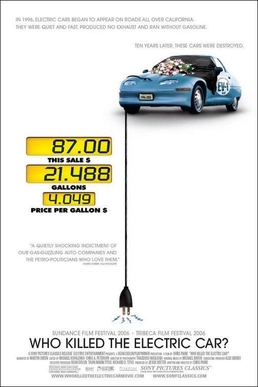
The 2006 documentary Who Killed the Electric Car? explores the creation, limited commercialization, and eventual demise (by self-destruction) of a battery operated electric vehicle known as the EV1. Produced by General Motors, the EV1 was was allowed to be leased by a few individuals in Southern California--many of them actors, like Tom Hanks, who went on David Letterman to sing its praises.
However, its successful roll-out and the threat it posed for a global oil dependent economy, sealed its fate. Like something out of a left-leaning Matt Damon-George Clooney thriller, an array of forces ranging from major auto manufacturers to the oil industry--helped along by powerful figures inlcuding Condoleeza Rice, Dick Cheney and others--came together to make certain that the EV1 would never make it into the mainstream public.
Before the car could even be marketed, General Motors suddenly and inexplicably recalled them, claiming they had no demand. Some of those leasing the cars offered to pay for them, but GM was adamant--demanding the return of their vehicles. Protests erupted with little media coverage, as some attempted to hold onto their EV1s. But eventually GM was successful. And the literally "confiscated" electric cars were not only retrieved but eventually crushed and destroyed. In a final insult, Exxon Mobil was allowed to buy the patent for the battery technology--assuring this threat would be nullified for the near future. The electric car disappeared from the roads of Southern California, and--until the 2006 documentary--remained unknown to most Americans.
Now here we are on the cusp of 2009. With a global recession, high gas prices, desperate automakers and a promise by a president-elect to move the US from oil dependency, the electric car seems as relevant as ever. One of the conditions of the recently proposed automaker bailout, should be that the Big 3 start looking to produce cars that are energy efficient, cheaper for buyers and less harmful to the environment. And someone in Congress should demand them--General Motors in particular--to come clean about who killed the electric car.
Link to film:
Who Killed the Electric Car?
Trailer for "Who Killed the Electric Car?"
Tom Hanks on David Letterman discussing the EV1.
Subscribe to:
Posts (Atom)


